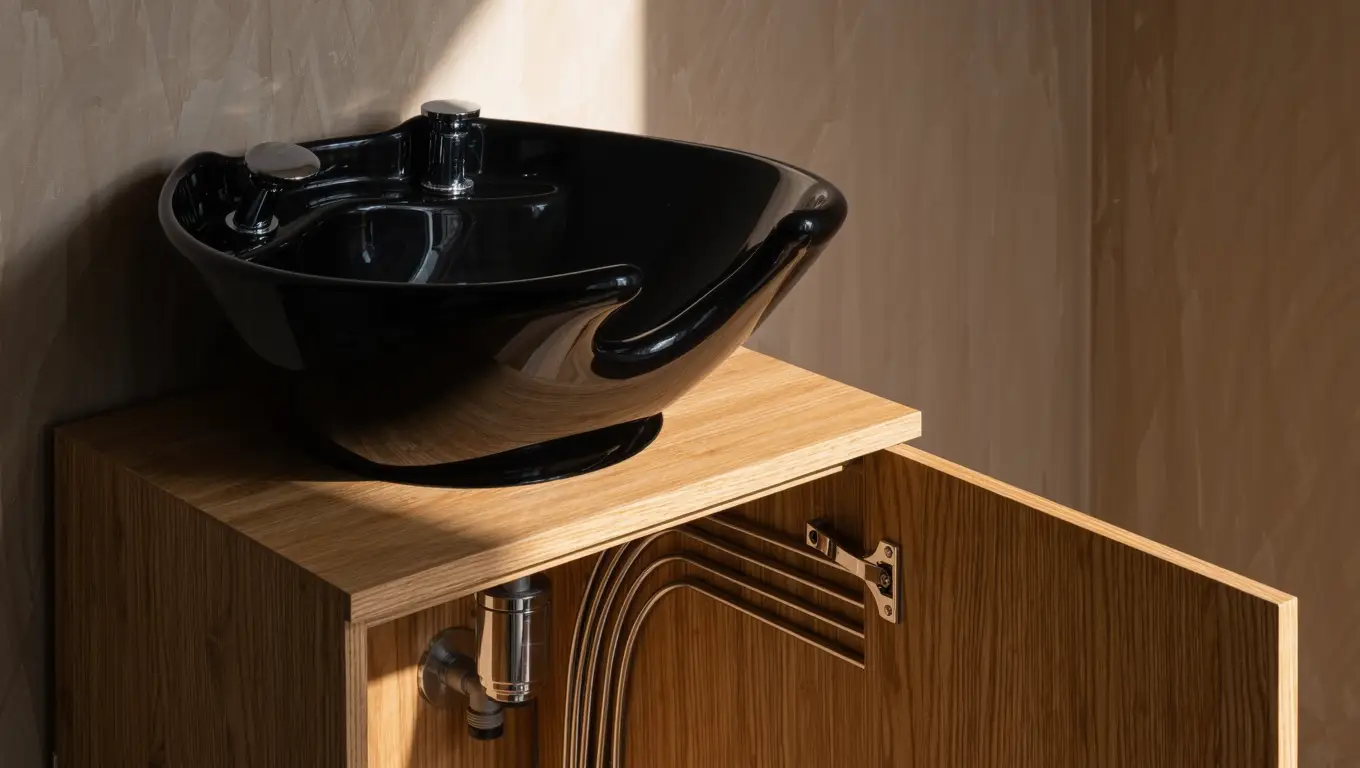
A salon shampoo bowl needs hot and cold supply lines (commonly 1/2 inch) with shutoff valves, backflow protection such as a vacuum breaker on the sprayer, a drain of about 1-1/2 inches with a code-compliant trap, and a hair catcher or under-bowl hair interceptor. A licensed plumber should install it to local code.
Key takeaways
- Get the exact model drawing before rough-in: drain height and position vary, and some units need the drain within about 2.4 inches of the floor.
- Check water pressure: one major manufacturer specifies 0.1 to 0.4 MPa (about 15 to 58 psi) at the unit.
- Pull-out sprayers create a backflow risk; plan a vacuum breaker or the device your local code requires.
- Under the model plumbing codes, a trap seal is 2 to 4 inches deep, within 24 inches vertically of the fixture outlet.
- Size hot water for the number of bowls running at once, not for the whole day.
Start with the drawing, not the pipe
Every shampoo bowl and backwash unit has its own connection layout. Before your plumber cuts the slab or opens the wall, get a dimensioned drawing that shows where the hot, cold and drain connections sit relative to the unit’s base and the wall, and at what height. Mistakes here are expensive: a drain stub 4 inches too far left can mean breaking concrete twice.
As an example of how specific these drawings are, Takara Belmont’s YUME shampoo unit installation manual lists 1/2 inch (13 mm) hot and cold connections at 50 mm (about 2 inches) height and a 40 mm nominal PVC drain (48 mm outside diameter, about the same as US 1-1/2 inch pipe) that must sit less than 60 mm (about 2.4 inches) above the floor. A unit like that is normally fed from below the floor or from a very low wall stub; a standard 18-inch-high vanity drain will not work.
When you order any shampoo or backwash unit from us, ask for the connection drawing with the quotation so your plumber can confirm the rough-in before production.
Water supply: size, pressure, temperature
Line size and valves
Most professional bowls connect with 1/2 inch hot and cold lines. Put an accessible shutoff valve on each line inside the cabinet or behind an access panel so a faucet cartridge or hose can be changed without shutting down the salon. Some manufacturers also call for check valves on each supply; the YUME manual specifies a stop valve and a check valve on each line, joined with flexible pipe.
Pressure
Takara Belmont’s RS III installation instructions require supply pressure between 0.1 and 0.4 MPa (roughly 15 to 58 psi), say pressure should not drop below 0.1 MPa when several units run together, and ask that cold pressure be at least equal to hot pressure, with no more than 0.2 MPa difference. Unequal pressure is a common cause of sprayers that swing from warm to cold mid-rinse. If your building pressure is high, your plumber may add a pressure-reducing valve.
Temperature
The same manual notes a built-in thermostat that limits outlet water to 53°C (about 127°F) and asks for supply hot water at least 10°C above the temperature you use at the sprayer. Many salons also add a thermostatic mixing valve at the heater. Clients notice temperature swings immediately, so this detail is worth getting right.
| Item | Typical requirement | Where the figure comes from |
|---|---|---|
| Hot and cold supply | 1/2 in, with shutoff valve on each | Takara Belmont YUME and RS III manuals |
| Supply pressure | 0.1 to 0.4 MPa (about 15 to 58 psi) | Takara Belmont RS III manual |
| Hot vs cold pressure | Cold at least equal to hot; difference within 0.2 MPa | Takara Belmont RS III manual |
| Outlet temperature limit | 53°C (about 127°F) via built-in thermostat | Takara Belmont RS III manual |
| Sprayer flow | 10 L/min (about 2.6 gpm) at 0.1 MPa | Takara Belmont YUME manual |
| Drain pipe | 40 mm nominal PVC (48 mm OD, about 1-1/2 in) | Takara Belmont YUME manual |
| Trap seal | 2 to 4 in deep | International Plumbing Code (ICC summary) |
Backflow protection and the sprayer
A pull-out sprayer can end up lying in a bowl full of dirty water. If supply pressure drops, that water can be siphoned back into the potable supply. Plumbing codes generally require backflow protection for this kind of connection, commonly a vacuum breaker located above the flood rim of the bowl, though the exact device and position depend on your local code. Some manufacturers ship it in the kit: the RS III manual describes a North America faucet kit with a pre-assembled vacuum breaker, check valves and flow regulators. If your bowl does not include one, your plumber will specify and install the correct device. Your inspector will look for it.
Drain, trap and venting
The International Code Council’s overview of International Plumbing Code trap requirements sets out the rules most US jurisdictions build on:
- Each fixture is separately trapped by a liquid-seal trap; double trapping is not allowed.
- The trap seal is at least 2 inches and no more than 4 inches deep.
- The vertical distance from the fixture outlet to the trap weir is no more than 24 inches, and the horizontal distance no more than 30 inches.
- S-traps, bell traps, crown-vented traps and traps with moving parts are prohibited; drum traps are only allowed as solids interceptors or on chemical waste systems.
Some jurisdictions use the Uniform Plumbing Code or local amendments instead, so your plumber and local inspector have the final word. Slope the drain line consistently; the RS III manual gives a gradient of 1/50 for pipes of 75 mm or less.
Hair traps and interceptors
Hair is the main reason salon drains clog. There are two levels of protection:
Hair catcher in the bowl
A removable strainer in the drain port. Most professional bowls include one; the YUME manual, for instance, places the hair catcher in the drain port under the drain cap. Staff should empty it after each client and wash it at the end of the day.
Hair interceptor under the bowl
A dedicated fitting between the bowl outlet and the trap that collects hair in a removable basket. Watts, for example, describes its SI-750-TO hair interceptor as specified for under-sink hair collection, with a 1-1/2 inch inlet, a gasketed cover and a removable stainless steel sediment basket. Whether an interceptor is required is a local code question; many salons fit one anyway because it is far cheaper than calling a drain service.
| Protection | Where it sits | Cleaning | Required? |
|---|---|---|---|
| Bowl hair catcher | In the drain port | Empty after each client | Standard on most professional bowls |
| Under-bowl hair interceptor | Between bowl outlet and trap | Empty basket on a set schedule | Depends on local code; often recommended |
| Accessible cleanout | On the drain line | Used for rodding when needed | Per local plumbing code |
Sizing hot water for several bowls
The U.S. Department of Energy’s guide to sizing a new water heater explains the method: for a tankless unit, add up the flow rates of fixtures you expect to run at the same time and check the temperature rise the unit can deliver at that flow; for a tank, compare the first-hour rating with your peak-hour demand. Using the YUME sprayer figure of about 2.6 gpm per bowl as a planning estimate, simultaneous demand climbs quickly:
The DOE page notes that gas tankless units often deliver a 70°F rise at about 5 gpm and electric units at about 2 gpm. A salon with three bowls rinsing together may therefore exceed a single residential-size tankless heater. Ask your plumber to size for your busiest hour, and include the dispensary sink, laundry and any pedicure stations on the same heater.
Rough-in checklist for your plumber
- Dimensioned connection drawing for each bowl model.
- Supply and drain positions marked on the floor plan, including height above floor.
- 1/2 inch hot and cold supply with accessible shutoffs; check valves if the manufacturer requires them.
- Static and working pressure checked; pressure-reducing valve if needed.
- Backflow device for the sprayer per local code.
- Trap and vent to code; hair interceptor and cleanout access planned.
- Water heater sized for simultaneous bowl use; mixing valve set.
- Moisture sealing around pipes where they pass through the unit base (the YUME manual, for example, calls for a moisture-proof sheet and gasket).
- Permit pulled and inspection booked before cabinets close up.
Keeping the drain line healthy
California rule 16 CCR section 990, in the state board’s Article 12 health and safety rules, requires shampoo trays and bowls to be cleaned with soap and water or other detergent after each shampoo and kept in good repair. Build drain care into that routine: empty the hair catcher after every client, clean the interceptor basket on a fixed day each week (more often in busy salons), and never pour leftover color or chemical mixtures down a bowl in quantity. Other states have their own rules; check your local board.
For choosing the bowl itself, see our guide to shampoo bowl and chair units. Our tilting ceramic shampoo bowl and Cascade shampoo bowl and chair are built to order in our Foshan factory; we supply connection drawings with each quotation so your plumber can plan the rough-in early.
Frequently asked questions
What size drain does a shampoo bowl need?
Most professional shampoo bowls connect to a drain of about 1-1/2 inches. Takara Belmont’s YUME manual, for example, specifies 40 mm nominal PVC with a 48 mm outside diameter, about the same as US 1-1/2 inch pipe. Always confirm the size, height and position on your model’s drawing and follow your local plumbing code for the trap and vent.
Does a salon shampoo bowl need a vacuum breaker?
Usually yes. A pull-out sprayer can sit in dirty water, so plumbing codes generally require backflow protection, commonly a vacuum breaker mounted above the bowl’s flood rim. Some faucet kits include one; Takara Belmont’s RS III North America kit, for instance, ships with a pre-assembled vacuum breaker. Your local code and inspector decide the exact device required.
Is a hair interceptor required for a salon?
It depends on your jurisdiction. Most professional bowls include a hair catcher in the drain port, and many local codes or sewer authorities require or recommend an interceptor for salons. Even where it is optional, an under-bowl hair interceptor with a removable basket is a low-cost way to prevent clogs. Ask your plumber or local building department.
How big a water heater does a salon with shampoo bowls need?
Size it for your busiest hour. The U.S. Department of Energy method adds up the flow of fixtures running at the same time and checks the required temperature rise. At roughly 2.6 gpm per sprayer, three bowls rinsing together approach 8 gpm of mixed water. Include other sinks and pedicure stations, and have a licensed plumber do the final sizing.
Planning your wash area? Request a quote through our request a quote page and we will send connection drawings for each bowl with your pricing.
Sources
- Takara Belmont — YUME Shampoo Unit Installation Manual
- Takara Belmont — RS III Shampoo Unit Installation Instructions
- International Code Council — An overview of plumbing trap requirements under the IPC
- Watts — SI-750-TO Chrome Plated Hair Interceptor
- U.S. Department of Energy — Sizing a New Water Heater
- California Board of Barbering and Cosmetology — Article 12, Health and Safety
Fitting out a salon?
Send your floor plan or model list. Our factory replies with specifications, lead times and freight to your ZIP code within one business day.

