TB117-2013 is California’s smolder-resistance standard for upholstered seating, adopted nationally as 16 CFR part 1640 from June 25, 2021. Upholstered furniture made or imported since then must comply and carry a permanent compliance label. Proposition 65 is separate: it requires warnings in California when products expose people to listed chemicals such as some phthalates.
Key takeaways
- The federal rule covers indoor seating with an upholstered seat, back or arm; its text has no explicit residential-only limit, and whether every commercial salon chair falls within it is not fully settled, so ask for compliance anyway.
- The required label reads exactly “Complies with U.S. CPSC requirements for upholstered furniture flammability.”
- California also requires a flame retardant chemical statement on TB117-2013 labels and bans added flame retardants above 1,000 ppm in covered furniture since January 1, 2020.
- Prop 65 short-form warnings must name at least one chemical for products labeled from January 1, 2028; the rule took effect January 1, 2025.
- Ask your supplier for test reports, label artwork and a materials list before production, not after delivery.
Why upholstery rules matter for salon furniture buyers
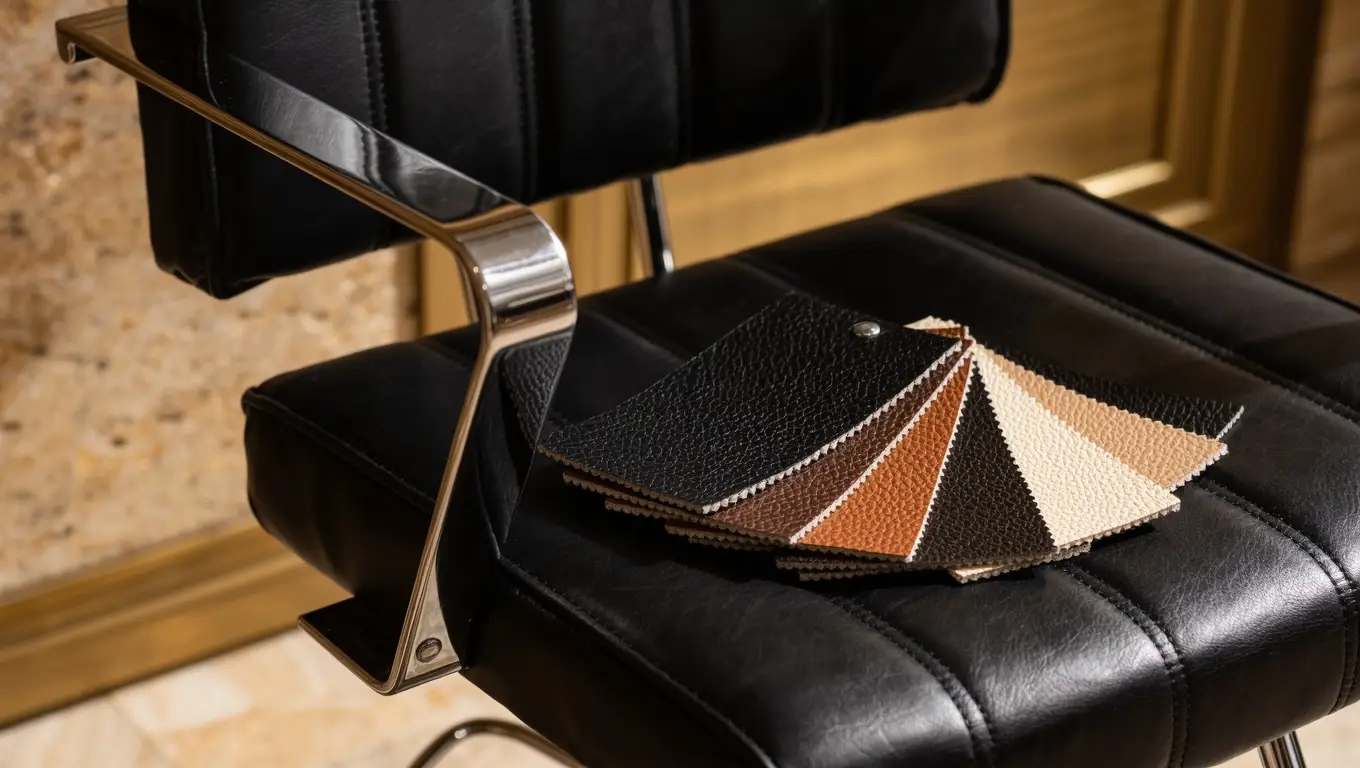
Styling chairs, barber chairs, shampoo chairs, pedicure thrones, waiting sofas and reception seating are all upholstered. They usually combine a vinyl or PU cover, polyurethane foam and a plywood or metal frame. Three sets of rules apply to those materials when they are sold in the United States:
- Flammability: the federal upholstered furniture standard based on California TB117-2013.
- California flame retardant rules: a labeling statement and a sales ban on added flame retardant chemicals.
- California Proposition 65: warnings for exposure to listed chemicals, which can include some plasticizers in vinyl.
Most buyers only hear about these rules when a distributor or a California customer asks for paperwork. Knowing them in advance makes sourcing smoother, especially when you import directly.
TB117-2013 and the federal standard, 16 CFR part 1640
TB117-2013 is a California Technical Bulletin titled “Requirements, Test Procedure and Apparatus for Testing the Smolder Resistance of Materials Used in Upholstered Furniture.” It tests how cover fabrics, barrier materials, resilient filling and decking materials behave when exposed to a smoldering cigarette, rather than to an open flame.
The COVID-19 Regulatory Relief and Work From Home Safety Act made TB117-2013 a federal requirement. The U.S. Consumer Product Safety Commission published the direct final rule in the Federal Register on April 9, 2021, codified at 16 CFR part 1640. Key points from the rule:
- Effective date: June 25, 2021, for upholstered furniture manufactured, imported or reupholstered on or after that date.
- Label compliance date: June 25, 2022.
- Requirement: all upholstered furniture must comply with the California standard, TB117-2013.
- Label: a permanent label with the fixed statement “Complies with U.S. CPSC requirements for upholstered furniture flammability.” The wording cannot be varied.
- Certification: the general certificate requirement of section 14(a) of the Consumer Product Safety Act does not apply; the label serves as the certification of compliance.
- Preemption: states generally cannot set their own flammability rules for upholstered furniture, with exceptions for certain California regulations.
Does it apply to commercial salon chairs?
The definition in 16 CFR 1640.3 covers seating furniture intended for indoor use, movable or stationary, with an upholstered seat, back or arm, that can support a person sitting upright or reclining. It excludes mattresses, foundations, bedding products and furniture used exclusively for physical fitness and exercise. The rule text does not carve out commercial or contract furniture, but how it applies to purely commercial salon seating has not been fully settled in published guidance.
The practical answer for a salon owner or distributor: specify compliance anyway. It costs little when built into production, it satisfies California and many corporate buyers, and it avoids awkward questions from landlords, insurers and franchise groups. California also repealed its open-flame public occupancy test, TB 133, effective January 22, 2019, and the state’s Bureau of Household Goods and Services says in its AB 2998 FAQ (cited below) that upholstered furniture for public occupancies there must now meet TB117-2013.
| Component | What TB117-2013 evaluates | What to ask your supplier |
|---|---|---|
| Cover material (vinyl, PU, fabric) | Smolder resistance of the cover fabric | Test report for the exact cover material and color family |
| Barrier material (if used) | Barrier performance under the smolder test | Whether a barrier is used and its test report |
| Resilient filling (foam, fiber) | Smolder resistance of the filling | Foam type and test report; confirm no added flame retardants |
| Decking materials | Smolder resistance of decking | Material list for seat decking |
| Finished product | Permanent federal label | Label artwork and location before production |
The table summarizes the components named in the federal rule. The pass and fail criteria are set in TB117-2013 itself; your testing lab or supplier should provide the reports.
California’s flame retardant label and ban
California adds two requirements on top of smolder resistance.
The flame retardant statement (SB 1019)
Since January 1, 2015, upholstered furniture sold in California that must meet TB117-2013 carries a flame retardant statement. According to the state’s Bureau of Household Goods and Services FAQ, the statement goes on the same TB117-2013 label, to the right of or below the flammability wording, with an “X” marking either “contain added flame retardant chemicals” or “contain NO added flame retardant chemicals.” “Added” means above 1,000 ppm, measured per component. The label must be at least 2 by 3 inches, type at least 1/8 inch high, and the Proposition 65 label must be separate. Manufacturers must provide supporting documentation within 30 days of a Bureau request.
The flame retardant ban (AB 2998)
Since January 1, 2020, California prohibits the sale or distribution of new and reupholstered upholstered furniture containing covered flame retardant chemicals above 1,000 ppm in cover fabrics, barrier materials, resilient filling or decking. The Bureau’s FAQ states it applies to public occupancy furniture too, and that it applies regardless of when the product was manufactured. In practice, a piece labeled as containing added flame retardants should not be sold in California.
The good news: TB117-2013 is a smolder test, and smolder resistance can generally be met through material choices, so flame retardant chemicals are not required to pass it.
Proposition 65 and vinyl upholstery
Proposition 65 is a California right-to-know law. It requires businesses to give clear and reasonable warnings before knowingly exposing people to chemicals on the state’s list. According to OEHHA’s plain-language overview, businesses with fewer than 10 employees are exempt from the warning requirement, businesses get 12 months after a chemical is listed to comply, and penalties can reach $2,500 per violation per day.
Furniture is a frequent subject of Prop 65 notices. The state’s furniture products fact sheet explains that phthalates may be used in plastic furniture and vinyl textiles on cushions and upholstery, that some polyurethane foams contained flame retardants before California’s 2020 ban, and that formaldehyde can be released from composite wood and some coatings. All of these can appear in salon furniture, which is why many US sellers show a DEHP warning on vinyl chairs.
The 2025 short-form warning changes
Amendments adopted in late 2024 changed the short-form warning. According to SGS’s summary, the amendment took effect January 1, 2025, with a three-year transition to January 1, 2028. After that, short-form warnings must name at least one chemical. Products already labeled with the older short form can continue to be sold during the transition, and a 6-point minimum type size still applies.
| Rule | Scope | Key date | What it requires |
|---|---|---|---|
| 16 CFR part 1640 (TB117-2013) | Upholstered indoor seating, nationwide | June 25, 2021 (label by June 25, 2022) | Smolder resistance and fixed permanent label |
| California SB 1019 | Upholstered furniture sold in California subject to TB117-2013 | January 1, 2015 | Flame retardant statement on the TB117-2013 label |
| California AB 2998 | New and reupholstered upholstered furniture sold in California | January 1, 2020 | No covered flame retardants above 1,000 ppm |
| Proposition 65 short-form update | Products sold in California with warnings | January 1, 2025, mandatory by January 1, 2028 | Short-form warning names at least one chemical |
A compliance checklist for importing upholstered salon chairs
- Specify materials in writing. Cover material (PVC vinyl, PU or fabric), foam type, and a statement of no added flame retardant chemicals.
- Request test reports for TB117-2013 on the cover and filling materials actually used in your order.
- Approve label artwork before production: the federal statement, and the California TB117-2013 label with the flame retardant statement if you sell into California.
- Decide on Prop 65. If you or your customers sell in California and have 10 or more employees, decide with counsel whether a warning is needed and which chemical to name, or specify cover materials made without phthalates.
- Keep a file per model: materials list, test reports, label photos and shipment dates.
- Check each state board for any sanitation rules on seating surfaces, such as nonporous, cleanable upholstery.
Our factory in Foshan can build salon styling chairs and barber chairs to your material and labeling specification. Ask for the current compliance documents per model at quote stage; our quality and compliance page explains how we handle inspections and paperwork. For electrical items such as pedicure chairs, see our pedicure plumbing and electrical guide.
Frequently asked questions
Is TB117-2013 mandatory outside California?
Yes, as a federal rule. Since June 25, 2021, upholstered furniture manufactured, imported or reupholstered for the US market must comply with TB117-2013 under 16 CFR part 1640, and since June 25, 2022 it must carry the permanent federal compliance label. Application to purely commercial salon seating is not fully settled, so most suppliers comply for all upholstered seating.
What does the TB117-2013 label have to say?
The federal label must read exactly: “Complies with U.S. CPSC requirements for upholstered furniture flammability.” It must be permanent. Furniture sold in California also carries the state TB117-2013 label with an “X” marking whether the product contains added flame retardant chemicals or no added flame retardant chemicals, on the same label, at least 2 by 3 inches.
Do salon chairs need a Prop 65 warning?
Only if they are sold in California, the business is not exempt (fewer than 10 employees are exempt), and the product exposes people to a listed chemical, such as certain phthalates in PVC vinyl. Many sellers warn for DEHP. From January 1, 2028, short-form warnings must name at least one chemical. Talk to counsel about your situation.
Do salon chairs need flame retardant chemicals to pass TB117-2013?
No. TB117-2013 is a smolder-resistance test, and it can generally be passed through cover, barrier and foam choices. California also bans covered flame retardants above 1,000 ppm in upholstered furniture sold there since January 1, 2020, so specify “no added flame retardant chemicals” in your purchase order.
Sources
- Federal Register — Standard for the Flammability of Upholstered Furniture, direct final rule (April 9, 2021)
- California Bureau of Household Goods and Services — Flame retardant chemical statement FAQ
- California Bureau of Household Goods and Services — AB 2998 FAQ
- SGS — California approves amendment to Prop 65 warning methods
- OEHHA — Proposition 65 in plain language
- OEHHA Prop 65 Warnings — Furniture products fact sheet
Send us your chair specification and target markets and we will include compliance documents with your factory-direct quote.
Fitting out a salon?
Send your floor plan or model list. Our factory replies with specifications, lead times and freight to your ZIP code within one business day.

