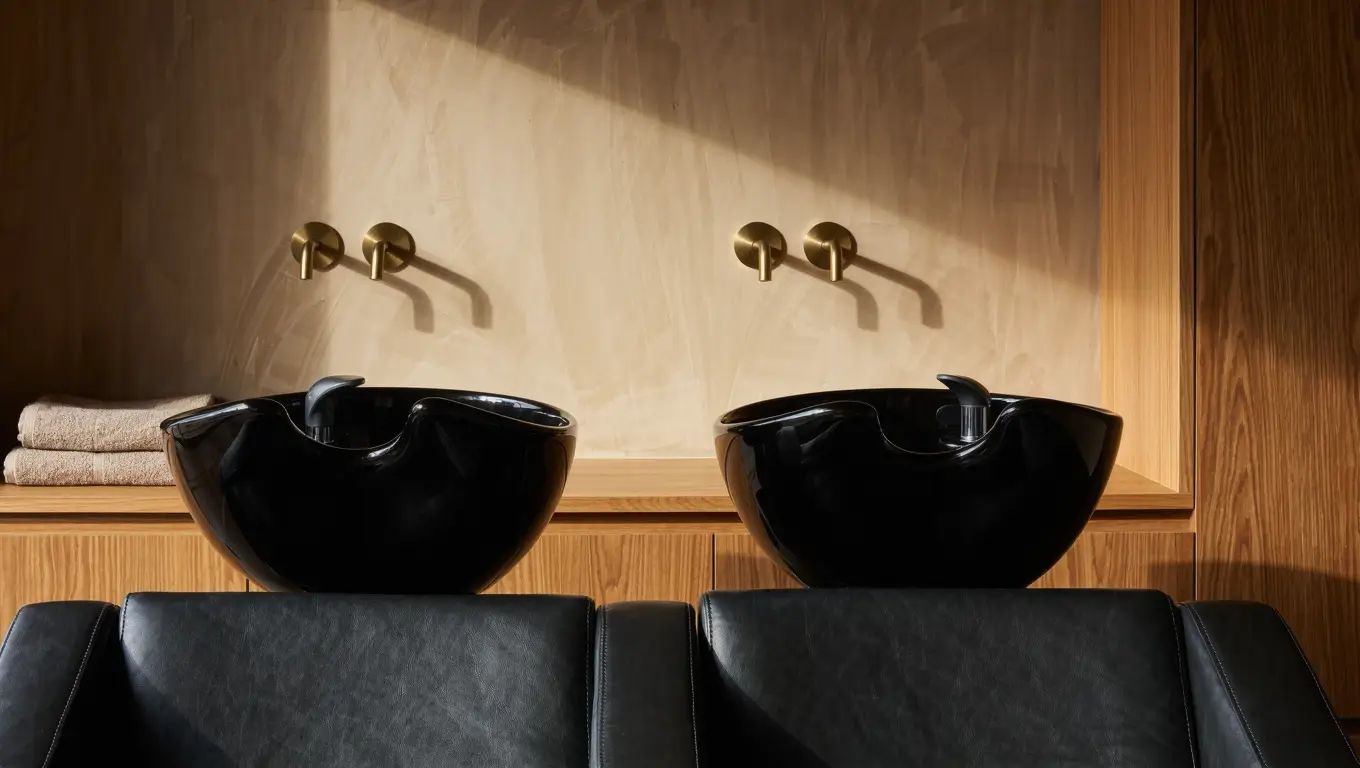
Choose a shampoo bowl and chair by format first: a one-piece backwash unit (bowl and chair joined) for a tidy, fixed wash row, or a separate bowl and chair for flexibility and easier replacement. Then check bowl tilt and neck rest, chair recline and leg rest, rim height, clearances, and the plumbing your contractor needs.
Key takeaways
- One-piece backwash units save planning time and look uniform; separate bowls and chairs are easier to repair, rearrange and mix.
- A tilting bowl with a soft neck rest matters more to client comfort than chair padding.
- Leg-rest backwash units suit color-heavy salons and long treatments; standard units suit quick rinses.
- Allow working room behind the bowl: one major manufacturer’s manual calls for at least 660 mm (about 26 inches) from the basin end to the wall on some models.
- Every bowl needs hot and cold supply, a drain with a trap, a hair catcher and usually a vacuum breaker, installed by a licensed plumber.
The three main formats
One-piece backwash unit
The bowl, cabinet and chair are joined on one base. You set the unit, connect water and drain, and the bowl height and chair position are already matched. Our Cascade shampoo bowl and chair is this type: a deep matte black ceramic bowl with a tilting neck rest, an attached reclined chair and a chrome spray hose and faucet.
Best for: new builds, salons that want an identical row of wash stations, and owners who want fewer decisions.
Backwash unit with leg rest
A longer, more reclined body with a leg rest (manual or electric) so the client lies back with legs supported. Our recline backwash unit with leg rest has an electric extending leg rest and a tilting white ceramic bowl. These units take more floor and usually need a power outlet, but clients stay comfortable for longer services such as color rinses, gloss treatments and scalp massages.
Separate bowl and chair
A wall-mounted or cabinet bowl paired with a stand-alone shampoo chair. The tilting ceramic shampoo bowl on an oak cabinet is a typical example. If the chair wears out, you replace only the chair; if you change the layout, the chair moves without disconnecting plumbing. It also lets you put an all-purpose reclining chair at the bowl in a small suite.
| Factor | One-piece backwash | Backwash with leg rest | Separate bowl and chair |
|---|---|---|---|
| Floor area | Medium | Largest | Flexible; chair can move |
| Client comfort on long services | Good | Best | Depends on chair |
| Height match bowl to chair | Set at the factory | Set at the factory | You must check it |
| Power needed | Usually no | Yes, if the leg rest is electric | No |
| Repair or replacement | Whole unit is one piece | Whole unit; motor is an extra part | Replace bowl or chair separately |
| Typical use | Busy salons, uniform rows | Color and treatment salons, spas | Suites, barbershops, refits |
Bowl details that decide comfort
Tilt and neck rest
A tilting bowl lets the stylist angle the bowl to the client’s neck instead of forcing the client to adjust. Look for a smooth tilt that locks in position and a soft silicone or rubber neck rest that sits where the neck meets the rim. Neurologists have described a rare condition known as beauty parlor stroke syndrome, associated with leaning the head back over a rigid basin rim. The Conversation’s summary notes it is rare and recommends neck support during the wash. A good neck rest and a correctly matched chair height are the furniture side of that advice.
Bowl material
- Ceramic or porcelain: hard glazed surface, resists staining from color, heavy. The standard choice in professional salons.
- Acrylic or composite: lighter, warmer to the touch, more colors; check how it resists scratches and dye staining.
- Black vs white: black hides color stains; white shows cleanliness and suits bright interiors. Both clean the same way.
Faucet and sprayer
Professional bowls use a single-handle or thermostatic mixer and a pull-out spray head. Ask whether the faucet set includes a vacuum breaker and check valves for the North American market; one Japanese maker’s RS III installation manual, for example, ships its North America faucet kit with a pre-assembled vacuum breaker, check valves and flow regulators. Confirm the hose length reaches the full width of the bowl.
Hair catcher
A removable hair catcher in the drain port is the first defense against clogs. Some salons also install a dedicated hair interceptor under the bowl. See our shampoo bowl plumbing guide for drain and trap details.
Heights and clearances
US backwash units commonly list a seat height around 21 to 22 inches, a bowl rim around 39 to 40 inches and an overall depth around 45 inches. Those numbers give a starting point for space planning, but always work from the drawings for the exact model you order.
The space behind the bowl is where the stylist stands, so do not size the room only for the unit itself. Takara Belmont’s RS III shampoo unit installation instructions call for 660 mm (about 26 inches) or more from the end of the basin to the wall or furniture on several chair models, 700 mm (about 27.5 inches) for another, and a 500 mm (about 20 inches) aisle from the handrail to the wall. Use your own model’s figures, but treat these as a sanity check for a cramped plan.
| Planning item | Typical figure | Notes |
|---|---|---|
| Seat height (backwash unit) | About 21 to 22 in | Common in US listings |
| Bowl rim height | About 39 to 40 in | Match to stylist height where possible |
| Unit depth | About 45 in | More for leg-rest units when extended |
| Bowl end to wall | 660 mm (26 in) or more | Takara Belmont RS III, several models |
| Aisle behind units | 500 mm (20 in) minimum in that manual | Wider if staff pass while others wash |
| Spacing between units | Allow room for arms and towels | Check chair arm width on the drawing |
Ergonomics for your staff
Shampooing is repetitive bending. The California Board of Barbering and Cosmetology’s ergonomics guidance advises using a freestanding sink where available so the licensee can stand behind the client and reach the hair without twisting, and bending at the hips with a straight back. In furniture terms:
- Pick units that leave open floor behind the bowl so staff can stand square to the client.
- Avoid placing a bowl tight against a side wall unless the stylist works from behind.
- Match rim height to your team; a bowl that is too low pushes every wash into a forward bend.
- Provide anti-fatigue matting behind the bowls if your floor finish allows.
Sanitation and state rules
Bowls and chairs must be easy to clean. California rule 16 CCR section 990, in the board’s Article 12 health and safety regulations, requires shampoo trays and bowls to be cleaned with soap and water or other detergent after each shampoo and kept in good repair, and requires chair headrests to be covered with a clean towel or paper sheet for each client. Choose wipe-clean upholstery and avoid deep stitching where product and water collect.
How many plumbed bowls you need is a state matter. For example, Kentucky’s board adopted a policy for unplumbed water sources (approved June 8, 2026) that allows portable stations for some services but says salons offering chemical hair services must have at least one plumbed bowl. Check your own state board before planning a wash area around portable units.
How many bowls?
A common planning approach is to count how many clients are at the bowl at the same time at your busiest hour, not how many stylists you have. A cut-focused salon with short rinses needs fewer bowls per station than a color-focused salon where clients wait at the bowl through rinses, toners and treatments. Watch your own booking data for a few weeks before deciding, and leave space or rough-in for one more bowl if you expect growth.
Buying checklist
- Format chosen: one-piece, leg rest, or separate bowl and chair.
- Bowl material and color, tilt range, neck rest material.
- Faucet set: mixer type, spray hose, vacuum breaker and check valves for North America.
- Hair catcher included; under-bowl hair interceptor planned if wanted.
- Drawing with seat height, rim height, depth and reclined length.
- Clearance behind the bowl and aisle width checked on your floor plan.
- Power outlet location for electric leg rests (110 to 120V, 60 Hz).
- Upholstery color and seam style; flammability label confirmed.
- Spare neck rests, hair catchers and cushions ordered with the units.
- Warranty terms by component confirmed in the quotation.
Ordering backwash units factory-direct
Salon & Steel builds shampoo units to order in our factory in Foshan, China. Bowl color, upholstery and cabinet finish can be customized, and units can ship together with chairs and stations in one container or a consolidated shipment, with US door delivery by LTL freight. Electrical items such as electric leg rests are built for 110 to 120V, 60 Hz; ask for the listing status of each model when you request a quote. Browse the full shampoo and backwash units range to compare formats.
Frequently asked questions
Is a one-piece backwash unit better than a separate bowl and chair?
Neither is better in every case. A one-piece unit has the bowl and chair heights matched at the factory and looks uniform in a row. A separate bowl and chair is easier to repair, lets you swap or move the chair without touching plumbing, and suits suites and refits. Busy salons often prefer one-piece units; small spaces often prefer separates.
How much space do I need behind a shampoo bowl?
Use the manufacturer’s drawing for your model. As a reference, Takara Belmont’s RS III installation instructions call for 660 mm (about 26 inches) or more from the basin end to the wall on several models and a 500 mm aisle behind the handrail. Many salons allow more so staff can pass behind someone who is washing.
Do I need a leg rest on a backwash unit?
A leg rest helps when clients stay at the bowl for long periods, such as color rinses, treatments or scalp massages, because the legs are supported and the body sits at a gentler angle. For quick rinses in cut-focused salons, a standard backwash unit is usually enough and takes less floor space. Electric leg rests also need a nearby outlet.
Who installs a shampoo bowl?
A licensed plumber should connect the hot and cold supply, the drain, trap and any vacuum breaker, following your local plumbing code and permit requirements. If the unit has an electric leg rest, an electrician should confirm the outlet. Your furniture supplier provides the drawings and connection sizes your contractor needs to set the rough-in correctly.
Ready to plan your wash area? Share your floor plan and bowl count through our request a quote page and we will recommend the right units.
Sources
- Takara Belmont — RS III Shampoo Unit Installation Instructions
- California Board of Barbering and Cosmetology — Article 12, Health and Safety
- California Board of Barbering and Cosmetology — Ergonomics (Safe Salon)
- Kentucky Board of Cosmetology — Policy for Unplumbed Water Sources
- The Conversation — The hidden health risk of having your hair washed
Fitting out a salon?
Send your floor plan or model list. Our factory replies with specifications, lead times and freight to your ZIP code within one business day.


