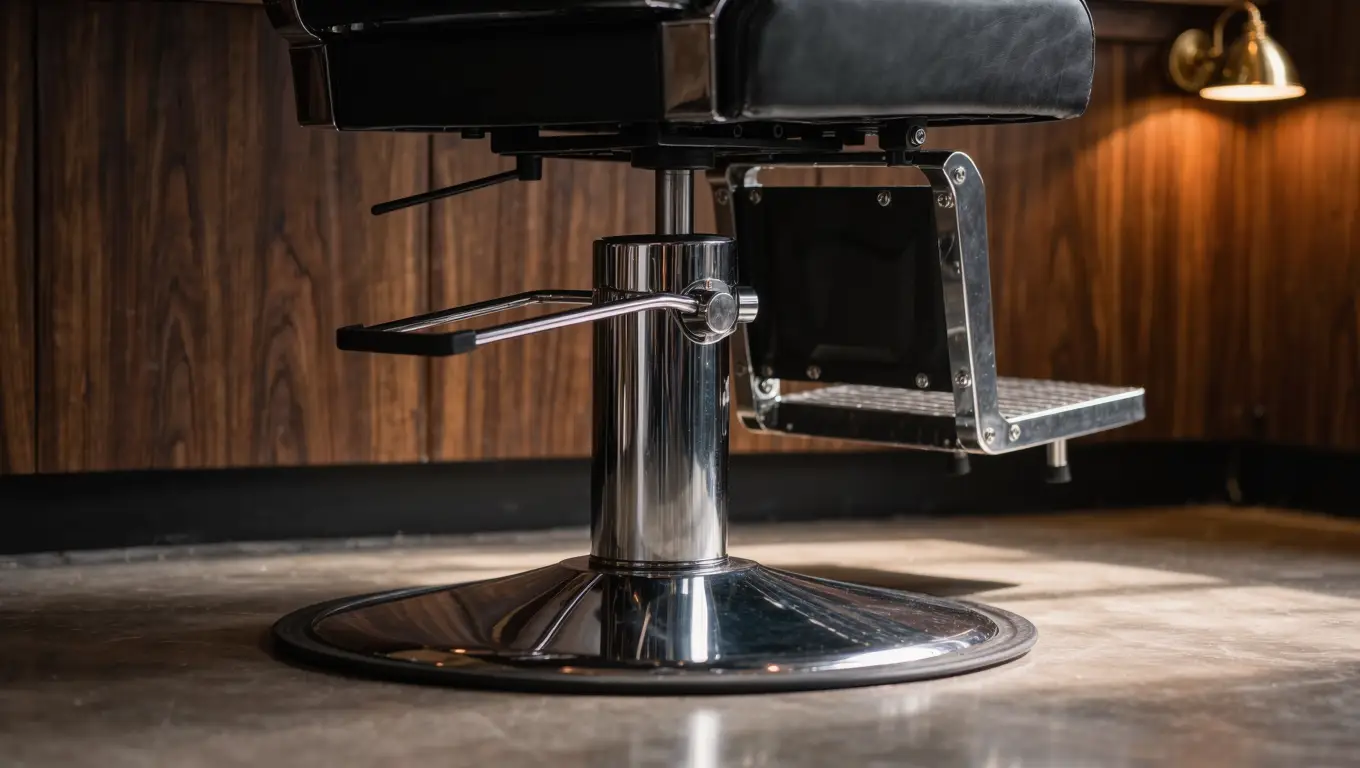
A barber chair hydraulic pump lifts the seat when the pedal is pumped, holds it at height, and lowers it through a release valve. Choose a pump with a seated load rating well above your heaviest clients, inspect it daily for sinking and oil leaks, and replace the whole pump assembly when seals fail.
Key takeaways
- Pump ratings vary widely. Styling-chair pumps are often listed around 250 to 300 lb, while heavy-duty barber bases are commonly listed from 300 lb up to 800 lb.
- A chair that slowly sinks, or oil on the base or pump cover, means the seals or valve are failing. Stop using the chair until it is fixed.
- A thin film of oil on the polished ram is normal. A puddle on the floor is not.
- Most shops replace the pump as a complete unit rather than opening it. Manufacturers warn against disassembling it.
- Wobble is usually loose base screws, not the pump. Check the cheap fix first.
How a barber chair hydraulic pump works
A hydraulic barber chair has a sealed cylinder in the base that holds hydraulic fluid and a piston, or ram, that carries the chair top. Each stroke of the foot pedal pushes fluid under the ram and lifts the seat a little. A check valve keeps the fluid from flowing back, so the seat holds its height. Holding the pedal down, or pressing a release, opens a valve that lets fluid return and the seat lower under its own weight.
The same pedal usually controls the rotation lock. In the Takara Belmont manual for its hydraulic salon and barber chairs, raising or lowering the chair releases the rotation lock. The operator re-locks it by lifting the center of the pedal. The manual also notes that lightly and continuously stepping on the pedal raises the chair, while pressing too hard lowers it. New staff often get that pedal action wrong.
Because the pump carries the client’s full weight on every lift, it is the component that decides whether a chair lasts years or months in a busy shop.
Pump ratings: what the numbers mean
Sellers describe pumps with a load rating, sometimes with a model code. The rating is the maximum seated load the base is designed to lift and hold. Here is how the classes commonly listed on the US market line up.
| Pump class (as commonly listed) | Typical listed seated load | Where it fits |
|---|---|---|
| Standard styling-chair pump (often sold as A-12 type) | About 250 lb | Light styling chairs, low-volume suites |
| Upgraded styling-chair pump (often sold as A-13 type) | About 300 lb | Busy salon styling stations |
| Barber chair base, standard | About 300 to 350 lb | Barber chairs with moderate client volume |
| Heavy-duty barber base | Listed up to 660 to 800 lb | High-volume barbershops, wide client size range |
Pump codes are not a regulated standard. Two sellers can use the same label for different parts, so always ask for the rating in pounds or newtons, in writing, for the exact base you are buying.
Read all the load limits, not just the pump
Manufacturers that publish full manuals list several limits. In the Takara Belmont Classic-E base manual, the maximum load is 1,350 N (135 kgf, 300 lbf). It also notes that the raising speed of the seat declines as the maximum load is approached. That slowdown is a useful warning sign. If your chair lifts noticeably slower for some clients, you are working near the pump’s limit. The hydraulic chair manual linked above also warns against putting 30 kgf (about 66 lb) or more on the footrest, or letting customers stand on the chair.
For a shop, the practical rule is simple: buy a base rated with clear margin over your heaviest regular client. Our heavy-duty hydraulic barber chair is built for that kind of margin, while a hydraulic styling chair suits salon stations where clients sit upright and lifts are lighter.
Daily and weekly care
Hydraulic pumps are sealed units, so care is mostly about inspection and keeping dirt and chemicals away from the seals and ram.
Daily inspection, about one minute per chair
- Pump the chair to full height with a person seated. It should rise smoothly and evenly.
- Leave it raised for a few minutes. It should hold height without sinking.
- Swivel it and lock the rotation. The lock should hold firmly.
- Look at the base and the pump cover for oil. Takara Belmont’s manual says any sinking, or oil leaking onto the base or through the pump cover, means you should stop using the chair and call for service.
- Listen for new knocks, squeaks or grinding when you raise, lower and swivel.
Weekly care
- Wipe the ram and base with a soft dry cloth to remove hair and product buildup. Hair wrapped around the ram can drag grit into the seals.
- Check that the base screws are tight.
- Keep disinfectant sprays and hair chemicals off the pump. Apply cleaners to a cloth, not directly to the chair.
What is normal
Not every sign of oil is a problem. The same manual explains that oil may collect on the ram from repeated raising and lowering. That film protects the sliding surface. Keep capes and clothing clear of the ram when cleaning, because they can pick it up.
Cold also affects pumps. The Classic-E manual notes that slow movement and noise at startup can happen when the internal fluid is cold, and that the chair recovers as it warms. If your shop is cold first thing in the morning, run each chair up and down a few times before the first client.
Troubleshooting common pump problems
| Symptom | Likely cause | What to do |
|---|---|---|
| Chair slowly sinks with a client seated | Worn internal seals or a leaking check valve | Stop using the chair; arrange pump replacement or service |
| Oil on the base, floor or pump cover | Failed outer seal or cracked housing | Stop using the chair; clean up the oil so no one slips; replace the pump |
| Pedal pumps but the chair will not rise | Low fluid, air in the system or a failed valve | Have a technician check it; do not open the cylinder yourself |
| Chair will not lower | Release valve stuck or linkage out of adjustment | Check the pedal linkage for debris; call for service if it persists |
| Slow lift for heavier clients only | Working near the rated load | Normal near the limit; consider a heavier-duty base for that station |
| Chair wobbles or rocks | Loose base screws, more often than the pump | Tighten or replace the base screws |
| Slow and noisy only first thing in the morning | Cold hydraulic fluid | Cycle the chair a few times; it should improve as it warms |
Fixing a wobble
Wobble feels like a pump failure, but it rarely is. An iFixit repair guide for a wobbly hydraulic barber chair traces the problem to loose or missing screws in the base. The fix: raise the chair fully, lift the seat off the column with a helper, remove the base ring, and refit six screws with washers. That chair used 1/4-20 x 1-1/2 inch flat head socket cap screws and a 7/32 inch hex bit. Check your own chair’s parts list before buying screws.
Repair or replace the pump?
Hydraulic barber chair pumps are sealed, pressurized assemblies. Takara Belmont’s manual tells owners not to disassemble, repair or modify the chair, and to contact a dealer for any malfunction. Most commercial pumps are designed to be swapped as a complete unit. In practice, replacement is the normal route for a shop.
Replacing a pump, in outline
- Confirm the exact pump model, rating and mounting pattern from your chair’s parts list or the supplier.
- Lower the chair fully and lock the rotation.
- With two people, lift the chair top off the pump column. Tops on heavy-duty chairs are heavy, so plan the lift.
- Unbolt the old pump from the base plate and fit the new one with the correct bolts.
- Refit the top, then test lift, hold, lower and rotation lock with a person seated.
- Dispose of the old pump and any oily rags according to local rules.
If you are not comfortable lifting the top or working on a raised chair, have a technician do it. Never work under a chair top supported only by the hydraulic column.
Keep a spare
For a shop with four or more chairs, keeping one spare pump assembly on the shelf is a sensible planning habit. A failed pump then costs you an hour, not a week of a dead station. When you order chairs as a matched set, the pumps are interchangeable, which makes this practical.
Why a failing pump is a compliance issue too
A sinking or leaking chair is a safety hazard for clients and staff. State inspectors also look at the condition of equipment. California’s board lists fines of $50 to $150 under 16 CCR §994 for furniture and fixtures that are not clean and in good repair, in its common violations list. Oil on the floor and a chair that will not hold height are exactly the kind of thing an inspector notices. Check your own state board’s rules.
Buying chairs with the pump in mind
When you compare chairs, ask every supplier the same questions:
- What is the pump’s seated load rating, in pounds, for this exact base?
- Is the pump sold as a separate spare part, and what is the part number?
- Are the warranty terms for the pump stated separately from the upholstery and frame?
- What fluid does it use, and is it ever meant to be topped up?
- How is the top fixed to the pump column, and what tools are needed to remove it?
At Salon & Steel we build chairs to order in our factory in Foshan, China. Each quotation lists the pump specification for the model, spare pump assemblies you can order with the chairs, and warranty terms per component. You can compare base options across our barber chairs, and see how pumps differ from motorized bases in our guide to electric vs hydraulic barber chairs.
Frequently asked questions
Why does my barber chair keep sinking?
A chair that slowly drops with a client seated usually has worn internal seals or a leaking check valve. That lets fluid return under load. It will not fix itself. Manufacturer guidance is to stop using the chair and contact service. In most shops the solution is replacing the pump assembly with the correct rated unit.
Can I add hydraulic oil to a barber chair pump?
Most commercial barber chair pumps are sealed and not designed for owner top-ups. Manufacturers generally do not publish a refill procedure and advise against disassembly. If a pump has lost fluid, it is also leaking, and the seal failure is the real problem. Ask your supplier whether the model is serviceable or should be replaced as a unit.
Is oil on the pump column normal?
A thin film of oil on the polished ram is normal. It comes from repeated raising and lowering and protects the sliding surface. Oil pooling on the base, running from the pump cover or reaching the floor is not normal. It signals a seal failure, and the chair should be taken out of service.
How much weight can a barber chair hydraulic pump hold?
It depends on the pump. Styling-chair pumps are often listed around 250 to 300 lb, standard barber bases around 300 to 350 lb, and heavy-duty barber bases from about 660 to 800 lb. Pump codes are not standardized, so get the rating for the exact base in writing before you buy.
Sources
- Takara Belmont — Hydraulic chair operating instructions (US)
- Takara Belmont — Classic-E base operating manual
- iFixit — How to fix a wobbly hydraulic barber chair
- California Board of Barbering and Cosmetology — Common violations
Planning a fit-out or replacing tired chairs? Use our request a quote form to price chairs with matching spare pump assemblies.
Fitting out a salon?
Send your floor plan or model list. Our factory replies with specifications, lead times and freight to your ZIP code within one business day.


